Hey everyone, thanks for popping in to my little corner of the sprinkler world! I’m Jake, and I run a Standard Response fire sprinkler supply company—you’ve probably seen my posts rambling about how getting the right sprinkler specs isn’t just “set it and forget it” stuff. Today I’m answering one of the most common questions I get from contractors, facility managers, even a few confused homeowners who stumbled on our site: What’s the actual minimum water flow rate for Standard Response sprinklers? Let’s dive into this, no stuffy engineering jargon that makes your eyes glaze over. Standard Response Fire Sprinkler
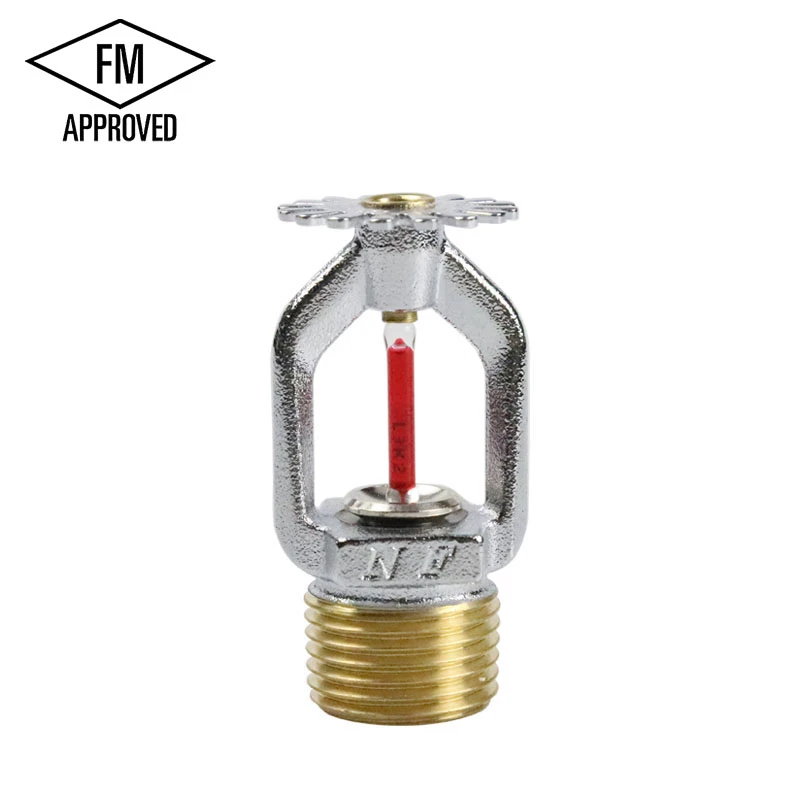
First, let’s get one big myth out of the way. A lot of people think “Standard Response” (let’s call it SR for short, everyone in the industry does) just means any old sprinkler that’s not fast-response. Nah, SR has a specific, baked-in definition from NFPA—that’s the National Fire Protection Association, the folks who write all the actual rules for fire safety. SR sprinklers have a specific heat activation threshold (usually 155°F for residential, 286°F for commercial, depending on the space) and a design flow rate that’s non-negotiable for them to work as intended.
Now, the minimum flow rate. This isn’t a random number someone pulled out of thin air. It all ties back to how SR sprinklers were engineered to fight fires without overdoing it. Let’s start with what flow rate even means here—for sprinklers, it’s gallons per minute (gpm) the sprinkler puts out when it’s fully activated, right? But it’s not just the per-sprinkler number; you also have to account for the pressure, because pressure and flow are linked. If your water pressure is too low, even if the pipe says it can push 20 gpm, you’re not gonna get that at the sprinkler head.
The base minimum for a single SR sprinkler, per NFPA 13, is 15 gpm. Wait, hold on—don’t roll your eyes like that number’s tiny. Let me put that in perspective: that’s like a standard garden hose, but focused into a targeted spray, not a mist. But why 15? Because SR sprinklers are made to cover a certain area—usually 144 square feet, that’s 12×12 feet, a pretty standard room size. To suppress a fire before it grows beyond that, you need that targeted stream to cool the fuel (like a couch, a stack of boxes, drywall) fast enough. Too low, and the water just evaporates before it hits the fire, or doesn’t penetrate the flame front.
But here’s the catch—minimum isn’t “set it and forget it” for the whole system. If you have a room that’s bigger, or it’s a commercial space with more potential fuel (like a storage closet full of cardboard boxes, or a server room), you might need more than just a single sprinkler. For example, in a retail stockroom, the minimum flow per sprinkler can go up to 22 gpm, depending on the hazard class. And if two sprinklers activate, you have to calculate the flow for both, plus any residual demand for the whole system. That’s where a lot of new contractors mess up—they just add 15 gpm per head and call it good, but NFPA 13’s hydraulic calculations are non-negotiable here.
Wait, let’s talk about pressure, because that’s the other half of the equation. If your sprinkler is rated for 15 gpm at 7 psi (pounds per square inch) of pressure at the head, you can’t get that flow if your pressure at the sprinkler is 5 psi. Most municipal water systems are built to hit that 7 psi minimum at the farthest sprinkler in a system, but if you’re adding a new wing to a building, or the existing pipes are old and corroded, your pressure drops. That’s when you have to install a pressure booster pump, not just crank the valves wider. I’ve seen this go wrong so many times—last year, a guy put in a system for a small café, forgot his pipes were 40 years old, had pressure tests that showed 6 psi, so his SR sprinklers only put out 12 gpm. When there was a grease fire, the sprinkler barely dented it, and the café had to close for two weeks. Don’t be that guy.
Another thing that affects flow rate is the type of sprinkler deflector. SR sprinklers have a specific deflector design— that’s the little plate at the end of the head that spreads the water. If you get a cheap knockoff deflector, it doesn’t spread the water evenly, so even if you have 15 gpm, half the spray is going to the ceiling and not hitting the fire. That’s why I only carry SR sprinklers from approved manufacturers—no off-brand stuff. I once had a customer who saved 10% buying a no-name SR head, and when we tested it, the flow distribution was 30% lower than it should be. Total waste of money.
Now, let’s get into specific applications, because not all spaces need the same minimum. For residential homes, the NFPA 13D (that’s the residential sprinkler standard) uses a slightly lower minimum, right? Wait, no—actually, 13D SR sprinklers still have a minimum of 15 gpm, but they cover smaller areas, like 10×10 feet, which makes sense because home fires are smaller usually. I tell homeowners all the time: if you’re retrofitting a house with SR sprinklers, don’t skimp on the flow rate. I had a guy try to use a lawn sprinkler as a test once (don’t laugh, he was serious) and it put out way too much and flooded his basement. SR is designed for fire suppression, not watering grass.
Commercial spaces, though, get trickier. Let’s take an office building—hazard class is “ordinary hazard group 2,” so minimum flow per SR sprinkler is 15 gpm, 7 psi. A storage warehouse with pallets? That’s “ordinary hazard group 3,” minimum jumps to 22 gpm per sprinkler. High-hazard stuff, like flammable liquids? Even higher, like 30+ gpm, but that’s usually not SR, that’s high-performance sprinklers. But for 90% of the projects I handle, it’s 15 or 22 gpm.
Wait, what about common mistakes people make? Oh, so many. One big one is testing flow rate wrong. A lot of guys just open the test valve on the sprinkler and measure how much water comes out, but they don’t account for the fact that the test valve is a simpler path than the sprinkler head. To get the actual flow at the sprinkler, you need to use a flow meter attached directly to the head, or do a hydraulic calculation from the main line to the head. Another mistake is assuming that if one sprinkler works, all will. If your system is designed for 15 gpm per head, but your water main only pushes enough for 12, every sprinkler in the system is underperforming. That’s a ticking time bomb.
Let me explain why the minimum is 15 gpm, not lower. Fire science 101: a fire needs three things—fuel, oxygen, heat. Sprinklers work by removing heat. For a typical room fire, you need to remove about 80,000 BTUs per minute to knock it down. 15 gpm of water can absorb that much heat (water absorbs about 8 BTUs per pound, and a gallon is 8.3 pounds, so 158.38 = ~1000 BTUs? Wait, no, let me get that right—wait, no, when water turns to steam, it absorbs a ton more heat. Oh right, latent heat of vaporization is like 970 BTUs per pound. So 15 gpm is 124.5 pounds per minute, times 970 is ~120,000 BTUs. That’s enough to cool a small room fire before it spreads. If you drop that to 10 gpm, that’s ~80,000 BTUs, which is just barely enough for a tiny fire, but once the fire gets a little bigger, it can keep going. That’s why 15 is the line—safe margin, not just the bare minimum.
I also get asked if fast-response sprinklers have a lower minimum. Nope, fast-response is for high-risk areas where heat builds fast, but their minimum flow is actually similar? Wait, no, some fast-response have lower flow, but SR is built for the broader, more common hazards, so their minimum is standardized to make installation easier for contractors. That’s one of the reasons SR is so popular—you don’t need custom flow calculations for every small space, you can use the 15 gpm number and be compliant, as long as the spacing is right.
Now, what happens if you go below that minimum? We talked about the café, but I’ve seen a warehouse fire where the sprinklers only put out 12 gpm. The fire was in a stack of cardboard boxes, and the sprinkler’s spray only put out a small spot on the top box, so the fire burned through the sides of the stack, spread to adjacent boxes, and took out half the storage area before the fire department arrived. The insurance company ruled the system non-compliant, so the owner had to pay for all the damage out of pocket. That’s not a story I want anyone to experience.
Wait, let’s also mention NFPA 25, which is the standard for maintaining fire sprinkler systems. When you do annual flow tests, you have to verify that each sprinkler is putting out at least the minimum flow rate it was designed for. If a test shows a sprinkler is only putting out 12 gpm, you have to troubleshoot—clogged pipe, bad pressure, faulty head—before the next inspection. I see this all the time with old systems that have mineral buildup in the pipes, reducing flow. A good flush every 10 years can fix that, way cheaper than a fire loss.
Now, if you’re a contractor installing a new SR system, or a property manager testing an old one, what do you need to do first? Grab the NFPA 13 (or 13D for residential) code book, look up the hazard class of the space, confirm the minimum flow per sprinkler, then do a hydraulic calculation to make sure your pipes, pumps, and water supply can deliver that flow at every sprinkler. And if you’re buying SR sprinklers, make sure they’re UL-listed or FM-approved—those are the two major third-party testing groups that confirm they meet the flow and performance standards.
Let’s talk about my job here. I don’t just sell sprinkler heads— I make sure people get the right ones for their project. A lot of suppliers will just give you whatever is cheapest, but that’s not how fire safety works. When someone reaches out to me, I ask them what type of space they’re working on, how big the rooms are, what kind of fuel is in there, and I help them figure out exactly what flow rate they need, not just push the cheapest product. That’s why so many contractors come back to me— I don’t just do a transaction, I help them do the job right, safely.
Wait, one last myth: some people think “minimum flow rate” means that’s all you ever need. No, that’s just the baseline. If you have a large open space, like a gymnasium, you might need more than 15 gpm per SR sprinkler because the fire can spread faster in a big, open area. NFPA allows for higher flow rates based on the hazard assessment, so don’t assume 15 is a hard cap. It’s a minimum, not a maximum.
Let me wrap this up. The key takeaways: Standard Response sprinklers have a minimum flow rate of 15 gpm per head for most ordinary hazard spaces, 22 gpm for higher ordinary hazard spaces, per NFPA standards. This isn’t a random number—it’s calculated to provide enough heat absorption to suppress a fire before it spreads. You also have to account for pressure, pipe condition, and sprinkler quality to make sure that 15 gpm actually gets to the head, not just written on a spec sheet. Testing annually, using compliant heads, and doing proper hydraulic calculations are non-negotiable.
If you’re planning a project that requires Standard Response sprinklers, or you need to update an existing system to meet code, don’t guess at the flow rate. I’m here to help you sort through all the rules, avoid the common mistakes that lead to failed inspections or worse, and get you the right SR sprinklers and support you need to do the job safely and right. Just reach out—no pushy sales stuff, just real advice from someone who’s been in this industry for years, has seen the good, the bad, and the ugly when it comes to fire sprinklers.
Fire Monitor References
NFPA 13, Standard for the Installation of Sprinkler Systems
NFPA 13D, Standard for the Installation of Sprinkler Systems in One- and Two-Family Dwellings and Manufactured Homes
NFPA 25, Standard for the Inspection, Testing, and Maintenance of Water-Based Fire Protection Systems
UL 199, Standard for Standard Response Sprinklers for Fire Protection Service
FM Global Data Sheet 2-0, Sprinkler System Installation Requirements for Industrial Occupancies
Nonfir Automatic Sprinkler Co., Ltd.
As one of the most professional standard response fire sprinkler manufacturers and suppliers in China, we have world-leading production equipment and strong manufacturing capabilities. Please feel free to buy advanced standard response fire sprinkler at competitive price from our factory.
Address: No.8, Yuanfeng Road, Meiyuan Village, Kangmei Town, Nan’An City, Quanzhou City, Fujian Province, China
E-mail: info@nfsprinkler.com
WebSite: https://www.nonfirsprinklers.com/
